



Former Prime Minister (PM) Rajiv Gandhi’s government did something in 1986 that tells you most of what you need to know about Seychelles. When a coup threatened President France-Albert René, India sent warships. Not a statement, not an envoy, but warships to a country of a 100-odd islands and barely 100,000 people, half an ocean away.
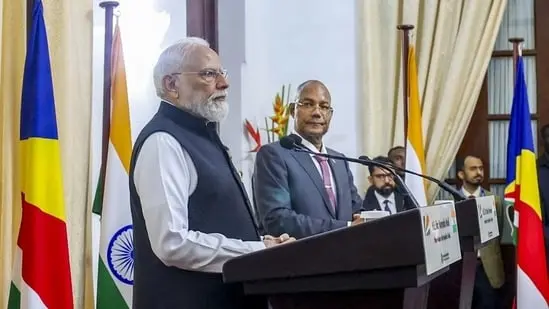
That instinct is back. PM Narendra Modi landed in Victoria on June 27 as guest of honour for Seychelles' 50th National Day, which is also 50 years of diplomatic ties, and the visit is being wrapped in the language of friendship and shared democracy. The friendship is real. It is not why the PM crosses the ocean for an archipelago this small.
He crosses it because of where the archipelago sits.
Seychelles lies in the western Indian Ocean, off the East African coast, near Madagascar and the mouth of the Mozambique Channel, astride the lanes that carry Gulf oil east and African ore west. Hold a position here and you can watch a great deal of the ocean without owning a single carrier. India's own western approaches run through this water. For New Delhi the islands work as a forward set of eyes — spotting pirates, tracking ships, and keeping an enormous exclusive economic zone under some kind of watch.
Geography like this does not wait for the present crisis to become useful. It was useful in the Cold War too.
The Americans ran a satellite-tracking station on Mahé and built their Indian Ocean reach around Diego Garcia to the south-east. The Soviets pushed their navy into the same water. When René seized power in 1977 and steered his one-party State toward Moscow, the West took fright, enough that in 1981 a gang of mercenaries flew in posing as a rugby-and-beer club, tried to topple him, fumbled it, and fled by hijacking an Air India jet to South Africa. Five years later came another plot, and that was when the Indian warships appeared off Mahé.
So, the pattern is old. Whenever the Indian Ocean turns into a place where large powers collide with one another, this little country gets pulled into the middle of it. It is happening again, with a difference.
China began with anti-piracy patrols off the Gulf of Aden in 2008. Respectable, legal, and welcomed. Then the patrols stayed. Then came the base at Djibouti, and a long, patient courtship of the East African coast paid for in ports, loans and quayside infrastructure.
On the face of it, India's worry is that Beijing wants a naval base in Seychelles next year. That misses what actually keeps planners in Delhi up at night. The fear is slower and harder to point a finger at: A decade in which Chinese visits become agreements, agreements become quiet access, and a small State, courted long enough and generously enough, simply leans. You do not need a base to own an island's foreign policy. You need its gratitude and its debt.
India's answer is to be the partner who turns up with useful things and no fine print. Modi is handing the Seychelles Coast Guard a fast patrol vessel, one more in a line that already runs through Dornier surveillance aircraft and earlier boats. The joint exercise Lamitye — "friendship" in Creole — was just raised to a full tri-service drill. India strung a coastal-radar chain across the islands, feeds them shipping data, runs their hydrographic surveys, arrives first when the cyclones hit. All of it now travels under the banner Modi unveiled in Mauritius last year, MAHASAGAR, successor to his older SAGAR formula — security and growth offered as a hand rather than a hook. Seychelles can tell the two offers apart. That is India's real edge, and it should stop being shy about pressing it.
And then there is Assumption Island, where the gap between strategy and politics gets brutal.
India and Seychelles agreed in 2015 to develop facilities on Assumption, revised the deal in 2018, and watched it die in the Seychellois parliament and on Seychellois streets, killed by a sovereignty backlash no military logic could talk down. New Delhi should not sulk over it. Assumption was never going to be a base so much as a lesson in how far a free country will let a friend go before its own voters yank the leash. The case for an Indian presence in these waters did not vanish when the project did. It simply has to find a form Seychelles can live with – slower, more thankless work than pouring a jetty.
Here is the part Delhi tends to forget once a State visit is over. Seychelles is not a stop on a goodwill tour. It is the door to India's western ocean and the African shore beyond it and the sharpest test of whether “neighbourhood first” survives contact with a place that is small, distant and proud. The flypast and the first-ever address to the National Assembly cost India nothing. The radar that still gets serviced after the handover photo, the credit line that actually reaches a Seychellois bank account. But India needs to sustain attention after the public events.
(The views expressed are personal)
This article is authored by Gaurav Sen, senior research fellow, Jawaharlal Nehru University, New Delhi.