



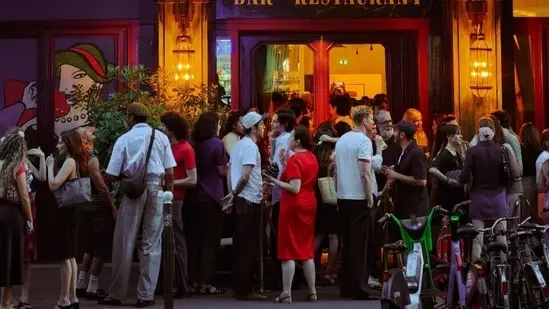
How long would you queue up at a restaurant for? Would you stand outside the door for 45 minutes till they let you in? A whole hour?
I guess it depends on how much you care. I don’t queue up at restaurants at all. I think it’s ageist for restaurants to not take reservations and to insist that people hang around on the street till they condescend to let them in.
But there are people who disagree with me. Many diners think nothing of waiting for two hours or more for a table. Over a decade ago when the New York baker Dominique Ansel invented the cronut, the rush to buy this cross between a croissant and a donut was such that the line outside his bakery would start at six in the morning.
The concept of having to queue up for food may sound like something out of Oliver Twist but it is often a tactic that restaurants use to get free publicity. I am convinced that the Hard Rock Cafe franchise would never have taken off if the original founders had not limited entry to the first Hard Rock in London. Every day, way back in 1971, a line consisting mostly of tourists would form outside the restaurant’s Park Lane location drawing attention to Hard Rock which claimed to capture the vibe of London’s rock-music scene. (Ha!)
So, the trend of queuing up for food and drink is not new. Later in the 1970s the disco/ nightclub Studio 54 would make non-celebrities line up. The owners and managers would decide which of the unfortunates dying to be admitted was cool enough to get in.
The idea of queues came from rock concerts where the line for tickets would often form two days before tickets even went on sale. It still survives with trendy bars around the world which like to have long lines outside their doors.
Also Read | The Taste by Vir Sanghvi: Rediscovering the old-world charm of Rome and its heritage
But rock tickets were available to everyone, not just cool people and most bars would now be criticised if they allowed entry on the basis of the perceived coolness factor that characterised Studio 54. Still, you have to lead a pretty empty life if your idea of fun is to spend Saturday night queuing up in the hope that hours later you will be allowed in to be able to fight your way to a bar counter to order an overpriced cocktail.
Sometimes restaurants are so small that queues are inevitable. When the original Barrafina opened in London two decades ago, it was a small counter serving Spanish tapas. During meal times you had to line up (unless like me you went at noon before the queue started). To avoid inconveniencing its guests too much the restaurant installed a webcam outside. You could go on the site, check how long the queue was and then decide if it was worth giving it a shot.
I discovered recently that the idea of using a web cam to shoot the line probably originated in New York. The city’s most celebrated restaurant Danny Meyer opened a small hot dog cart in Madison Square Park in 2001. A few years later he added hamburgers and other classic American street foods and Shake Shack became such a rage that the queues were unprecedented. Meyer installed a web cam to allow people to view the size of the queue. More significantly, he opened more Shake Shacks all over the world. (In a much smaller way Barrafina has done the same.)
The webcams were possible only because of the internet. And in many ways, the internet has actually promoted the queue culture at restaurants and bars that long to seem desirable. When it comes to rock concerts the opposite is true: The queue is dead; there are virtually no lines. People buy tickets on the net. Even restaurant bookings are usually done online now.
But the internet has promoted a social media influencer culture. Research shows that among the most common ways in which restaurant discovery occurs is through social media. People learn about new restaurants from posts on Instagram or YouTube or from specialist websites.
The restaurant influencers are not critics. They can’t pass judgements on food and even if they do, they lack the public trust to be taken seriously. What they can do, however, is post attractive pictures of the restaurant space or of the food itself.
These evoke some interest but the best way of demonstrating that a restaurant is worth going to is by declaring how popular it is. One method of proving that is by showing the number of people lining up to be admitted in a social media post.
That’s how the cronut craze started: By focusing on the line outside the Ansel bakery. And in major cities in America and Britain, almost any restaurant with a line is guaranteed to succeed. Why is Dhishoom the best-known Indian restaurant in Britain? The long queues outside each outlet help. Why is the new Haldiram’s in London allowing huge queues to form outside? The same sort of reason.
A decade ago, when London went through a burger boom, such restaurants as Meat Liquor and Burger and Lobster sprang to fame by not accepting bookings and asking people to line up. London’s pasta boom has also been fed by the queues outside such places as Padella.
Ironically, since the internet arrived, it has never been easier to book a restaurant because the technology is cheap and efficient. And yet, there are more restaurants that refuse to accept bookings than ever before.
In India, many less expensive places have always discouraged customers from reserving tables. Part of the charm of Delhi’s Sagar came from having to give your name to the man at the door and to then wait till they had room for you. (No lining up was encouraged. You were asked to come back in 15 minutes or so.) This assigning of tables was considered such an important part of the job that at the Defence Colony branch of Sagar, the owner Jayram Bannan would stand outside himself and take down the names of the people who wanted tables, long after he became a millionaire.
The tradition of having to wait for tables at dosa places has worked extraordinarily well for newer restaurants: Carnatic Cafe and most recently Benne, for instance. It’s helped along by social media and works on the cronut principle: If so many people are willing to wait in line, then the dosas must be good.
There are places like Jeremy King’s London restaurants (the Wolseley which King has since sold is the most famous) where 25% of the tables are reserved for walk-ins. At Bungalow in New York which is almost impossible to book because of the rush, owners Vikas Khanna and Jimmy Rizvi also set aside some tables for walk-ins every day. But because Bungalow is so popular, a queue forms anyway.
Can restaurants do without queues? Yes, of course they can. They simply need to allow people to book tables. Or, like Vikas Khanna and Jeremy King, they can accept reservations and also be kind and keep some tables for walk ins who couldn’t manage to get reservations.
Restaurants that don’t allow you to book because they want you queue up are -- in the final analysis-showing contempt for their customers by treating them like props in some social media extravaganza. They want long lines so that they can show off about how popular they are and create more hype for their restaurants.
It’s their choice and their decision. But it does tell you something about how they regard their customers.