



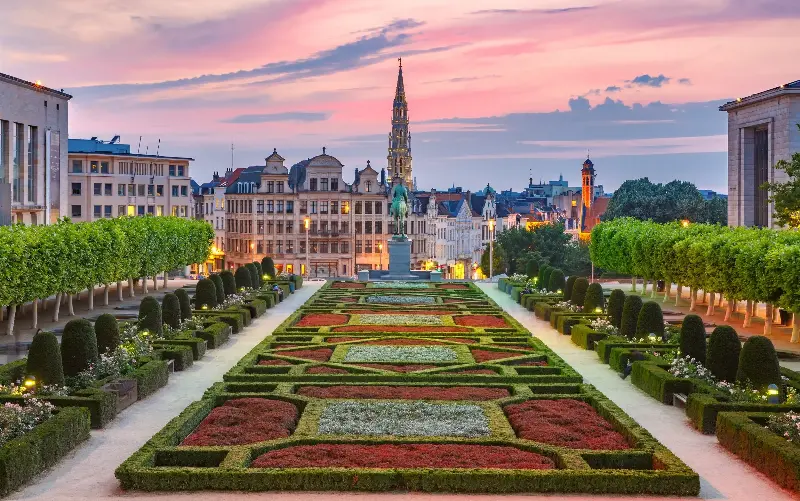
There are plenty of reasons to suggest Brussels is like no other city. It’s the capital of the European Union for a start (but you wouldn’t necessarily sense it) and it operates in two native languages (French and Dutch/Flemish).
The historic centre is a pentagon shape, with the imposing Grand Place in the middle. Among its central streets are sublime and surreal art collections (including from Bruegel, Rubens and Magritte), impressive churches, alluring shops, high-quality dining spots (such as the legendary chip stands), and splendid eccentricities, namely the Manneken Pis and Comic Art Museum (including the likes of Tintin) – and they’re all within walking distance.
Beyond the centre there are streets lined with Art Nouveau buildings, a museum packed with world treasures, and one of the best train museums in the world. There’s so much to choose from and be surprised by, as you sip the utterly unique local lambic beer, flavoured with cherries.
For more Brussels inspiration, see our guides to the city’s best hotels, restaurants, bars, and things to do.
In this guide:
How to spend a weekend
Day one: morning
All new visitors to Brussels should begin at the Grand Place, the historic central square; a magnificent coronet of guildhouses and joyously decorative civic buildings. Stand and gawp in wonder, and perhaps have a coffee (or early beer) on the terrace of Le Roy d’Espagne, a celebrated tavern in the old bakers’ guildhouse.
Now swallow your tourist pride and join the throngs heading down the Rue de l’Étuve to see the Manneken Pis. The tiny bronze statue of a little boy weeing originally dates back to the 15th century, and is often clothed in elaborate fancy dress that has become the city’s self-mocking icon. For the full monty, visit the selection of his 1,000 or so costumes at the GardeRobe MannekenPis museum.
After heading back across the Grand Place, walk through the splendid 19th-century shopping arcade, the Galeries Royales Saint-Hubert. It’s lined with exquisitely high-end window displays of luxury brands, such as local leather-goods manufacturer Delvaux, and top chocolate manufacturers, such as Mary. Then pop into the Cathédrale Saints-Michel-et-Gudule, a fine Gothic church completed in the 16th century.
Continue up the hill to reach the Parc de Bruxelles, the biggest green space in central Brussels, laid out formally with tree-shaded avenues. Walk south through the park to see the grand early 19th-century Palais Royal, the official headquarters of the King (usually open to the public late July and August), before entering the Place Royale to reach the Musée des Instruments de Musique, a collection of historic musical instruments in an old Art Nouveau department store. It’s top-floor restaurant with views over the city is currently closed for renovation (check the website).
For an alternative lunch spot, on the top floor of the Royal Library, or KBR, is Restaurant Albert, excellent for a light lunch or a sweet treat.
Afternoon
Now visit the Musées royaux des Beaux-Arts de Belgique, just a short walk along the Place Royale. This is Belgium’s premier art collection, and you could easily spend a whole afternoon here in the company of the Flemish Primitives, Bruegel and Rubens. There’s also the Magritte Museum, which occupies another wing. Works from the adjoining Musée Fin-de-Siècle, which has closed for restructuring, are available to see in temporary exhibitions.
After this, walk back to the centre of town via the Place du Petit Sablon, the lovely late-Gothic Eglise Notre-Dame du Sablon, and the chocolate shops of the Place du Grand Sablon.
Late
Drop in for some early-evening smooth jazz and a drink at the Art Deco-style L’Archiduc, then dine at one of the many restaurants in the now-trendy food hub of the Rue de Flandre/Place Sainte-Catherine area. The lively and ever-popular Le Pré Salé, has a fine collection of Belgian classic dishes, and is an excellent place to try moules-frites (steamed mussels and chips), served in epic proportions.
Day two: morning
Today, dip a toe into south Brussels, which grew as Belgium industrialised during the reign of King Leopold II from 1865 to 1909. First, stop by the Musée Art & Histoire located in the Parc du Cinquantenaire, created for and named after the 50th anniversary of Belgian nationhood in 1880. Inside is a world-class collection of Belgian and international artefacts in the mould of the British Museum.
Leaving the park, head west to the Robert Schuman roundabout, the gateway to the EU district flanked by several of its key institutions, such as the European Commission in the Berlaymont Building. To the south is Place Jourdan, at the centre of which stands Maison Antoine, a good place to sample the famed Belgian chips, along with traditional meal-sized snacks, such as carbonnade flamande (beef stew cooked in beer).
Afternoon
A walk through Parc Léopold leads to the wonderfully bizarre Musée Wiertz, the grand studio of Antoine Wiertz (1806-65), currently closed for renovation and due to reopen at some point in 2026 (date to be announced). But the afternoon’s principal destination is the Horta Museum, just over a mile to the south west, though public transport is available. Victor Horta (1861-1947) was the pioneer and supremo of Art Nouveau architecture, and this was his exemplary house and studio. Online reservations in advance of arrival are strongly recommended.
Now take a wander through this neighbourhood to see examples of Art Nouveau in situ, along Rue Defacqz and Rue Faider, for instance. On Rue Paul-Emile Janson is the Hôtel Tassel, thought to be the first ever Art Nouveau house, designed by Victor Horta and completed in 1893.
The top end of the Avenue Louise, along with the adjacent Boulevard de Waterloo, is the hub of the city’s luxury shopping area (Cartier, Hermès and the aforementioned Delvaux). Many of the shops here stay open until 6pm or 6.30pm.
Late
Admire the megalomaniac architecture of the Palais de Justice (built between 1866 and 1883) before an early dinner nearby at Colonel Louise. This is the style of restaurant Brussels does so well: a specialist in high-quality, carefully aged beef (see its display cabinet of the marbled raw product), but where everything on the menu – such as the cured meats, scallops and skrei (Norwegian Arctic cod) – is worthy of attention. Then head back into the centre for a beer or two at Moeder Lambic, where you’ll find several hundred to choose from.
When to go
Brussels is attractive throughout the year, especially in the bright weather of spring and early summer, and when the Christmas attractions are open in December. However, it can be distinctly chilly from January to April, and it may rain at any time of the year. Every season has its advantages: cosy bars in winter, versus the long, warm evenings in the summer, when it’s a joy to be outside. It’s worth noting that many of the major museums are closed on Mondays.
Where to stay
Luxury living
Short of being actually in the Grand Place, Hotel Amigo is about as close to the historic centre of Brussels as you can get. Olga Polizzi, sister of Sir Rocco Forte and designer for the Rocco Forte chain, has a subtle and distinctive style: unfussy, coolly stated luxury. The close attention to detail includes locally sourced fixtures and fittings, with a distinctive Belgian touch.
Boutique beauty
The core of Made in Louise dates from 1911, and the hotel still retains its historic charm with an original six-storey stairwell (there is also a lift), but everything has been upgraded with the flourish of a designer’s eye mixed with beguilingly “homemade” touches: white, black, cream and grey contrast with the bold wallpapers and calligraphy directions on the walls.
Budget bolthole
A former brewery is the industrial setting for MEININGER Hotel Brussels City Center, a novel property that is part of a dynamic German chain that aims to bring hotel standards to hostel culture. The result is good, flexible accommodation, an easy-going atmosphere, effective catering and highly competitive prices close to the heart of the city.
How to get there and how to get around
Brussels has an international airport at Zaventem, just to the east of the city, reachable by train, bus and taxi. High-speed Eurostar trains connect London St Pancras to Brussels-Midi/Zuid station in just over two hours. You can pay for public transport (operated by STIB) with a debit or credit card, or smartphone; or you can use a MOBIB card, obtainable at major stations, loadable with pre-purchased rides.
It’s easy to move across the city and the suburbs by public transport. Brussels is not very big – the historic centre, within the “Pentagon” is just 3km (just under two miles) across on its longest axis. The heart of the city largely pedestrianised and is very easy to manage on foot.
Know before you go
Essential information
- Emergency services: 112
- Brussels tourist office: 00 32 2 513 89 40; visit.brussels; counters at Grand Place (at the front of the Hôtel de Ville, Mon-Fri 9am-5pm, Sat 9am-6pm) and 2 Rue Royale (Place Royale), daily 9am-5pm.
The basics
- Currency: Euro
- Languages: French and Dutch are the two main native languages of Brussels (all street signs and most notices are written in both); English is widely spoken, especially among those working in tourism
- Telephone code: dial 00 32 for Belgium, then 2 for Brussels, when telephoning from the UK
- Time difference: +1 hour
- Travel times: Flights to Brussels from the UK take about one hour; the Eurostar train from London to Brussels takes two hours