



What’s the most famous street in the world? Probably New York’s Fifth Avenue, which has long been a traffic hellhole. In the UK, it’s most likely Oxford Street – a former road to execution, and, these days, an “ugly and scummy” strip. It’s clear that fame isn’t the same as greatness.
The very best streets are a combination of open-air museums, with a handy supply of bars or cafés, restaurants or rest areas to make the experience of walking (or riding) joyous and memorable.
Here are 20, in no particular order, that I think are truly special. Which streets, roads, avenues and alleys run most deeply through your travel memories? Please leave your comments below.
1. Strand, London
Possibly less well known than Oxford Street, the Strand is far more interesting. The name alludes to a beach or riverside and there’s officially no article before it. It links the Royal Courts of Justice, Fleet Street and Trafalgar Square with the West End’s Theatreland and Westminster’s political and religious institutions. Along its length are The Savoy, Aldwych and Charing Cross – the “zero point” of the UK’s road system. “Do the Strand!” sang Roxy Music. This classy Monopoly mid-price street (£220 to Park Lane’s £350) invites pedestrians to dance through old London history.
2. Philosopher’s Path, Kyoto
Japanese cities are good at neon, traffic and glassy skyscrapers, but this cherry tree-lined, stone-paved, canal-side, pedestrianised walkway offers a rare moment of calm.
3. George Street, Sydney
The city’s original high street, now in the Central Business District, George Street honours George III and runs from The Rocks to the western suburbs, passing under Sydney Harbour Bridge. As well as touching on many ways of living and working in Sydney, its route can also be traced to Aboriginal paths.
4. Registan, Samarkand
Uzbekistan’s most photogenic square on a street of the same name boasts three extraordinary madrasahs that are among the most beautiful buildings on the Silk Road. The name “Registan” means “sandy place”, which evokes the desert lives that inspired this architecture and the faith that underpins it.
5. Stroget, Copenhagen
This is widely considered the most famous and influential car-free pedestrian shopping street in the world. It runs from Radhuspladsen (City Hall Square) to Kongens Nytorv. Since Kierkegaard’s time in the mid-19th century, it has been the place to shop and see and be seen. Cafés provide plenty of pit stops for philosophical meditation.
6. Avenida de Mayo, Buenos Aires
Opened in 1894 and connecting the old colonial Plaza de Mayo with the Plaza del Congreso, this street gave Buenos Aires a wide, handsome boulevard overtly aping those built by Haussmann in Paris 30 years earlier. Café Tortoni, Dante-inspired Palacio Barolo and former La Prensa newspaper HQ are among its many standout buildings, as is the old Cabildo (town hall), which had three arches lopped off to make way for this elegant avenue.
7. Zhongshan Road, Shanghai
Zhongshan Road forms part of the waterfront strip of the Bund, in the former Shanghai International Settlement (the enclave shared by Britons and Americans from the 1860s). It’s the perfect place to admire European-style architecture alongside China’s modern obsession with verticality and nocturnal bling. A window-side table at Meet the Bund delivers perfect Fujianese cuisine with nostalgic decor and a view of the future.
8. Eixo Monumental, Brasilia
An “Axis” rather than a street, this is the kind of esplanade of effusive modernism that we might wish for in our own cities. The National Congress, Cathedral, Palácio Itamaraty (foreign relations HQ), Cultural Complex, Federal Tribunal and many other masterpieces lie along its length.
9. Straight Street, Damascus
Also known as the “Via Recta” and “Al-Shari’ al-Mustaqim”, this mile-long Roman decumanus maximus is the “street which is called Straight” mentioned in the Book of Acts, to which Saul of Tarsus was sent before he became Paul. It’s 2,500 years old, and is the home of the seat of the Antiochian Orthodox Church as well as the Midhat Pasha Souq.
The Foreign Office (FCDO) currently advises against all travel to Syria.
10. Sunset Boulevard, Los Angeles
This legendary road is 23 miles long and, like many streets in LA, is a highway along some sections. Linking downtown LA with the Pacific Coast, it passes through Beverly Hills and West Hollywood. Famed in the film and music worlds, it’s a metaphor for west-facing American aspiration or, if you like, California dreaming made asphalt.
11. Yonge Street, Toronto
Considered the main street of Canada’s biggest city, Yonge runs north from Lake Ontario for more than 50 miles, though it was once misleadingly claimed that it segued into Highway 11 and was the “world’s longest street”. Still, it’s quite a whopper and has plenty of shops, entertainment and cultural sites, and passes landmarks like Sankofa (formerly Yonge-Dundas) Square, the Hockey Hall of Fame and plenty of civic buildings. Part of Toronto’s oldest, and busiest, subway line runs along a long section, and is a great way to combine walks and rides.
12. Champs-Élysées, Paris
Despite stiff competition from assorted bridges, back streets and leafy parades in the French capital, the ultra-famous avenue – often viewed as the archetype of the grand boulevard – is too big and bold to be cast aside as a tourist trap. Topped and tailed by the Arc de Triomphe and the Place de la Concorde, it is liberally sprinkled with hotels, galleries, shops and cafés. At the south-eastern end, it segues into the Jardin des Tuileries and Louvre, as if it didn’t have enough monumentalism already.
13. Avenida Atlântica, Rio de Janeiro
All seaside proms have that ineffable quality of openness – to the roiling sea, to the elements, to sunshine, to hope. Copacabana’s, with its wave-like mosaic paving, is the fullest expression of the genre, and a throbbing, thriving theatre of carioca (Rio) life, from the bikini-clad skater and flip-flop-shod hustler to the open-mouthed tourist in his baggy Bermudas.
14. Khao San Road, Bangkok
Chaotic, clamorous, youthful, seedy, badly-behaved and overtouristed, this pulsating “backpacker” street is worth a visit if only to see what happens when global cultures collide and bad mai tais are sampled. Never pretty and not always safe, it is the frenzied preamble to many an island trip searching for “the beach”.
15. Broadway, New York
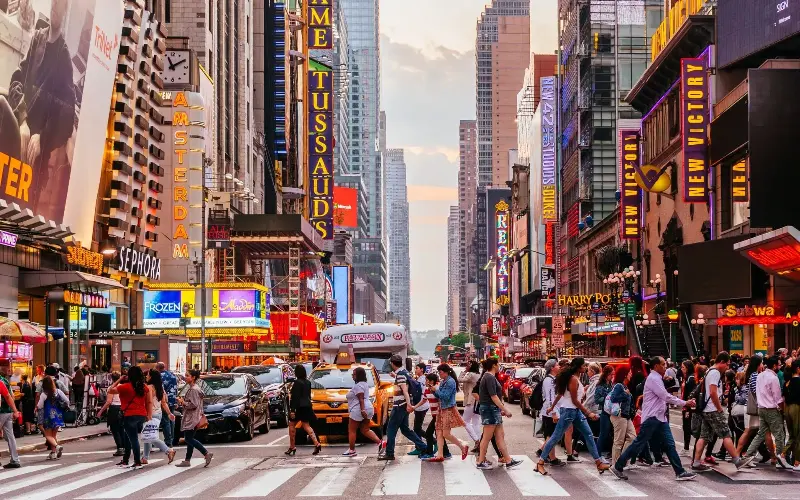
Manhattan has produced several metonymic addresses. The great theatre street just about pips Madison Avenue, Wall Street and Fifth Avenue. The Drifters’ song would be reason enough, but this 12-mile avenue is also the oldest north-south main thoroughfare in New York City, said to have been the Native American Wickquasgeck trail before the arrival of Europeans. It was a main street in New Amsterdam and today connects Times Square with Harlem and the Bronx.
16. Unter den Linden, Berlin
In the central Mitte district, this lime-tree-lined avenue runs from the Tiergarten and Brandenburg Gate to the Berlin Palace and Berliner Dom, passing by or close to the statue of Frederick the Great, Humboldt University, St Hedwig’s Cathedral, and several embassies. If Ku’damm is the ultimate symbol of retail-capitalism in the West Berlin era, Unter den Linden stretches back to the 17th and 18th centuries.
17. Gran Via, Madrid
With a good sampling of European and Spanish architectural styles along its length, including Plateresque, Mudéjar and Art Deco, and several iconic structures, such as the Beaux-Arts Metropolis Building, the Telefónica Building (one of Europe’s first skyscrapers), and Expressionist-cum-Rationalist Capitol Building, this is the Spanish capital’s most celebrated thoroughfare. It is also blessed with plenty of hotels, shops, cinemas and malls.
18. Malecón, Havana
Less a street than a way of life, catch the Cuban capital’s waterfront drag in the right light – morning or early evening – or, even better, under stormy skies, and you feel history and weather merging. Connecting Old Havana to Vedado, five miles away, it’s great for a long walk or a slow drive in an old car.
The FCDO currently advises against all but essential travel to Cuba.
19. 5a Avenida Norte, Antigua, Guatemala
The Arco de Santa Catarina, the cobbles, the Agua Volcano in the distance – they all work to draw your eyes up to the glittering skies above Guatemala. Colonial-era churches and convents, airy plazas and rain-stained, distressed pastel facades make this street a veritable three-dimensional painting.
20. Ebenezer Place, Wick
I am 6ft 3in, and if I were to lie down in a topper, I could nearly fill Ebenezer Place. Measuring just 6ft 9in, this tiny way in the atmospheric coast town of Wick is the shortest street in the world according to the Guinness World Records. Mackays Hotel is the sole addressee, and its restaurant doorway almost filling the entire space.